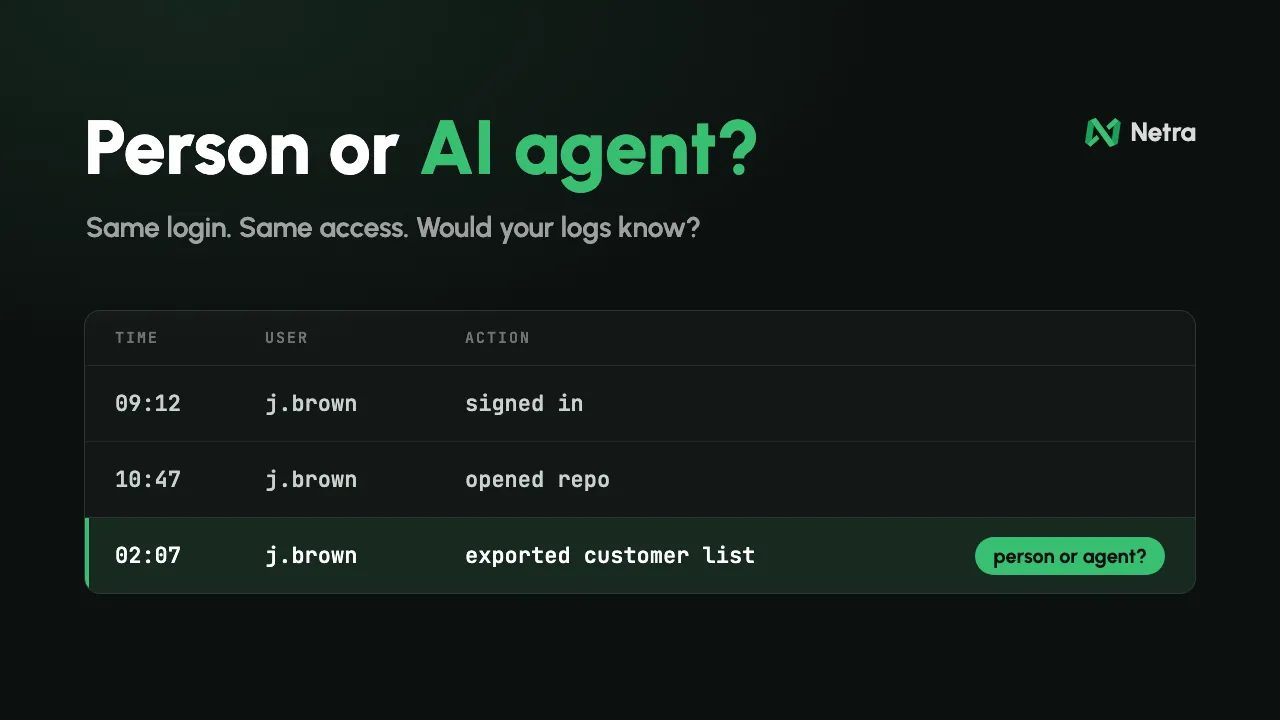
Your bank can’t tell if it’s you or your AI agent logging in.
Can your security team tell on your own laptops?
What the banks are seeing
Axios reports that major US banks are finding third-party AI agents inside customer accounts, signed in with the customer’s own credentials. Some appear to act on their own. Often the banks can’t tell which actions came from the person and which from the agent.
The response so far: block them, or allow read-only access. Axios reports that Morgan Stanley has started blocking agents, and that JPMorgan, Bank of America and Citi are restricting them.
The same blind spot on your laptops
Now look inside your own company. Coding agents like Claude Code and Cursor run on employees’ laptops with that employee’s files, tokens and access. To most security tools, the agent looks just like the employee.
Three questions to test yourself:
- Which actions came from the person, and which from the agent?
- Did the agent stick to its task?
- What data did it touch, and where did it go?
Without answers, you’re left with the banks’ options: ban agents, or limit them until they’re useless.
The better path
Attribute first, then scope.
That’s what we built Netra to do, on the device where the agent runs. Every agent session is tied to a user, device, process and model. Tool calls can be checked against the agent’s task. And a data event traces back to the agent task and tool calls behind it.
If an agent copied your customer list last night using an engineer’s access, would your logs say the engineer did it?