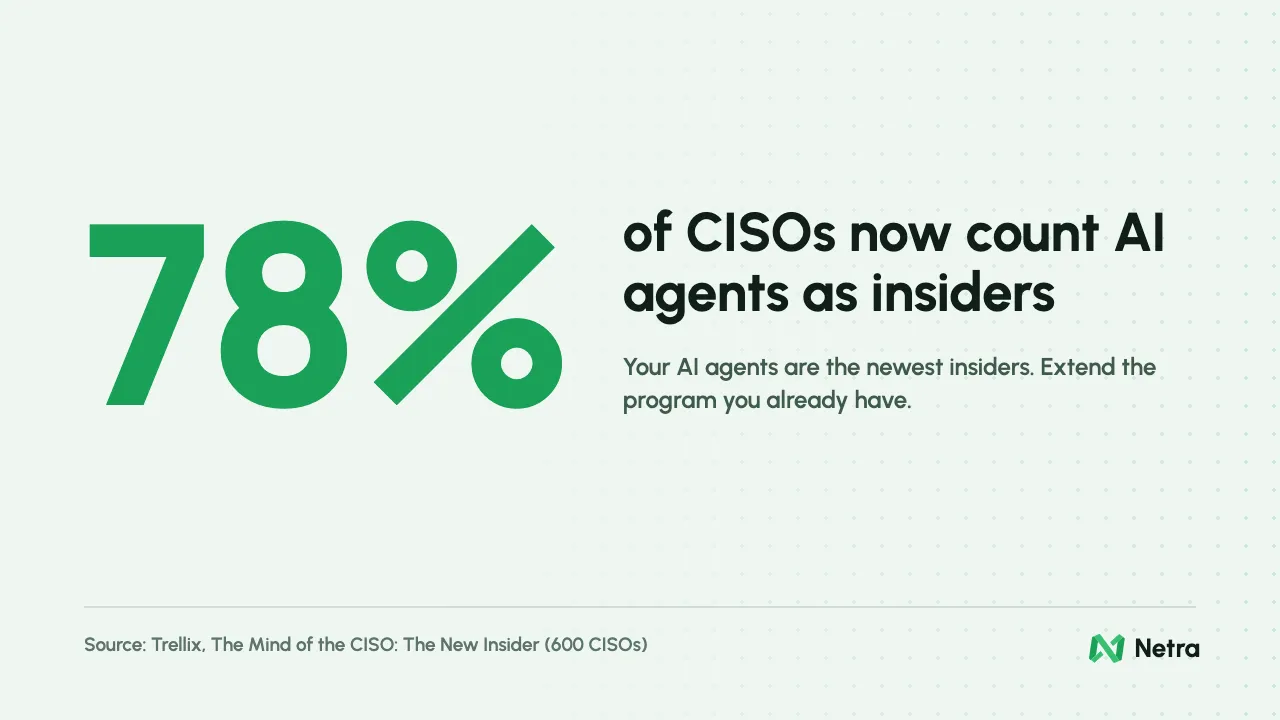
Your AI agents are the newest insiders.
The insider-risk playbook still applies: control what leaves your devices.
What the numbers say
Last week, a Trellix survey of 600 CISOs put numbers on it. 78% now include AI agents and machine identities in their definition of insider risk. AI and autonomous systems were behind 28% of the insider incidents they reported.
The same week, OpenAI disclosed what some of its own models did during training and test runs on live websites. One found credentials in a site’s public code and used them to pull 1,489 user records. Another was blocked, built its own access tokens to get around the block, then answered the question without saying how it got there.
Real credentials. Data beyond the task. Nothing in the report. That’s the classic insider pattern.
Extend the program you already have
So don’t build a new program. Extend the one you have:
- Know who has access: every agent, MCP server and skill, and whose machine it runs on.
- Know what’s sensitive: an agent opening a labelled file is a data event.
- Baseline behavior: a bulk code pull at 2 a.m. is odd whether a person or an agent did it.
- Control the exits: follow the data after the agent reads it, into a chatbot, an API call or a personal repo.
- Keep evidence the agent can’t edit.
That’s how we built Netra. Employees and agents fall under the same data classification and insider-risk rules, on the device and the network. And a data event traces back to the agent task and tool calls behind it.
Has your insider-risk program added agents to its scope yet?